Hawaiʻi's waters hold animals that most divers only see in documentaries: green sea turtles resting under ledges, critically endangered Hawaiian monk seals sleeping on the sand, spinner dolphins resting in sheltered bays, and in winter thousands of humpback whales. Their protection is layered. Some species are covered by the federal Endangered Species Act or Marine Mammal Protection Act, some by state law, and some by a mix of both. On top of the law sit NOAA's recommended viewing distances, which are guidelines rather than enforceable boundaries but are what wildlife officials ask everyone to follow.
For divers and snorkelers, the practical rule is simpler than the legal map: let the animal decide how close the encounter gets, and never be the reason it changes what it was doing.
- Sea turtles (guideline)
- 10 ft / 3 m
- Monk seals (guideline)
- 50 ft / 15 m
- Monk seal mom & pup
- 150 ft / 45 m
- Spinner dolphins (federal rule)
- 50 yd / 45 m
- Humpback whales (federal rule)
- 100 yd / 90 m
- Other dolphins (guideline)
- 50 yd / 45 m
Green Sea Turtles (Honu)
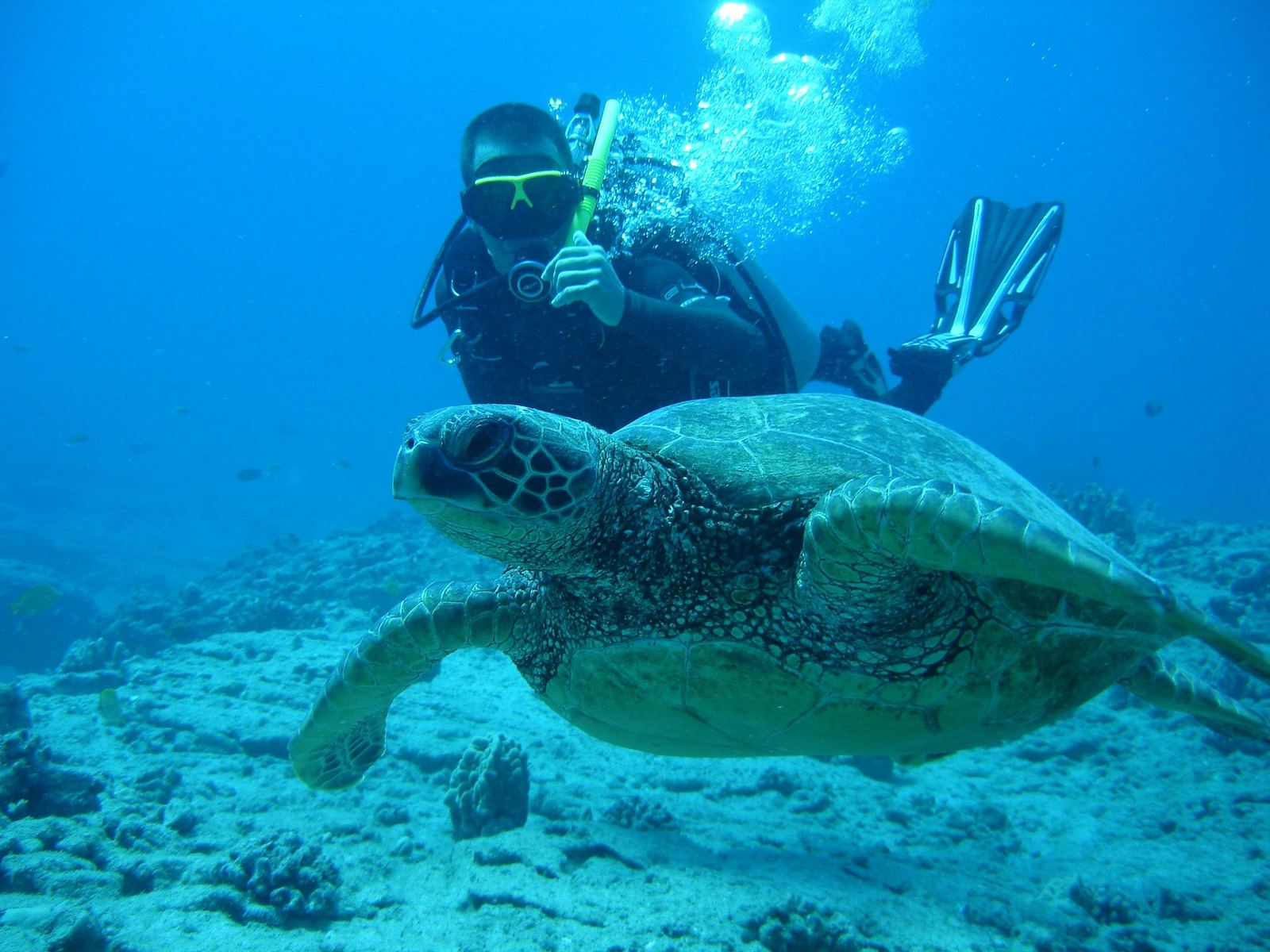
Turtles are the animal you are most likely to meet on any Hawaiʻi dive or snorkel. They graze on algae in the shallows, visit cleaning stations where reef fish pick at their shells, and haul out on beaches to rest and warm up. NOAA's guideline is to stay at least 10 feet (3 meters) away, in and out of the water.
- Never block the way up. Turtles breathe air. A turtle that cannot reach the surface because divers are hovering above it is under real stress.
- Do not chase or follow a turtle that swims away, and never touch or ride one.
- Let resting turtles rest. One wedged under a ledge or lying on the sand is not stuck or sick.
- Keep beach turtles undisturbed, and do not crowd them for photos.
Hawaiian Monk Seals
Hawaiian monk seals are found only in Hawaiʻi and are one of the most endangered seal species in the world. They often sleep on beaches for hours, which visitors sometimes mistake for distress. NOAA asks people to stay at least 50 feet (15 meters) away, and at least 150 feet (45 meters) from a mother and pup, because mothers can be protective and pups need uninterrupted nursing.
Monk seals are protected by federal law, and harassing, touching or harming one is also a Class C felony under Hawaiʻi state law. If a seal approaches you in the water, calmly move away. Do not try to play with it; seals that become used to people can become dangerous to swimmers and may end up being moved from their home area.
Hawaiian Spinner Dolphins
Spinner dolphins feed offshore at night and come into shallow, sheltered bays during the day to rest. Repeated disturbance during that rest period is exactly what the rule is designed to prevent. Since October 28, 2021, a federal rule under the Marine Mammal Protection Act has made it illegal to swim with, approach or remain within 50 yards of a Hawaiian spinner dolphin. It applies within 2 nautical miles of the main Hawaiian Islands and in designated waters between Lānaʻi, Maui and Kahoʻolawe, and it covers people, vessels and objects such as paddleboards and drones.
The rule has limited exceptions, for example when dolphins approach a vessel that is already underway. If dolphins swim toward you while you are diving, stay calm, do not reach out or follow, and let them pass. Any tour that advertises swimming with wild spinner dolphins in Hawaiʻi deserves a hard second look.
Humpback Whales
Humpback whales visit Hawaiʻi in large numbers in winter, with the season generally running from about November through May. Divers often hear their songs underwater. Federal regulations prohibit approaching a humpback within 100 yards (90 meters) by any means while on or in the water, and within 1,000 feet by aircraft, including drones. The rules apply year-round across Hawaiian waters, not only inside the national marine sanctuary.
If a whale surfaces near your dive boat, the captain will manage the distance. If you are in the water, stay with your group and let the whale move on.
Manta Rays
Hawaiʻi was the first state to protect manta rays. A 2009 law made knowingly capturing or killing a manta ray in state waters an offense, with fines that increase for repeat violations. On Kona's manta night dives and snorkels, the animals come to feed on plankton gathered by lights. The etiquette operators teach is consistent:
- Divers stay low and still, kneeling or settled on sand or rock, never rising into the feeding column.
- Snorkelers stay at the surface, holding the light board and floating flat with legs at the surface.
- Hands off. Touching can remove the mucus layer that protects a manta's skin from infection.
- Point lights where the briefing says, usually upward, to keep the plankton column in place.
Reef Fish, Octopus and Eels
Smaller animals deserve the same courtesy. Do not feed fish; it changes their behavior and diet, and feeding is prohibited in several Marine Life Conservation Districts, including Molokini Shoal and Kealakekua Bay. Do not poke octopus or eels out of their holes for a photo, and do not move sea urchins or shells to set up a shot. Collecting live coral, rocks or shells is restricted in many protected areas.
Photography Without Harm
- Get close with your lens, not your body. A wide lens or zoom does the work.
- Never hold or steady yourself on reef to get the shot. If your buoyancy is not yet good enough to hover, leave the camera on the boat for a few dives.
- Limit flash and video lights on resting or sleeping animals, especially on night dives.
- If the animal turns away or changes behavior, the encounter is over.
How to Report Harassment or a Hurt Animal
If you see someone harassing protected wildlife, or find an injured, entangled or stranded animal, do not intervene yourself. Note the time, location and any vessel name or description, and take photos or video from a safe distance. Hawaiʻi's Department of Land and Natural Resources takes reports through its Division of Conservation and Resources Enforcement and the free DLNRTip app, and NOAA Fisheries runs a marine wildlife reporting line for injured, entangled or stranded marine mammals and turtles. Current numbers are listed on the NOAA Fisheries Hawaiʻi viewing page.
Mālama i ke kai: care for the ocean. On a dive, that mostly means patience and keeping your distance.