
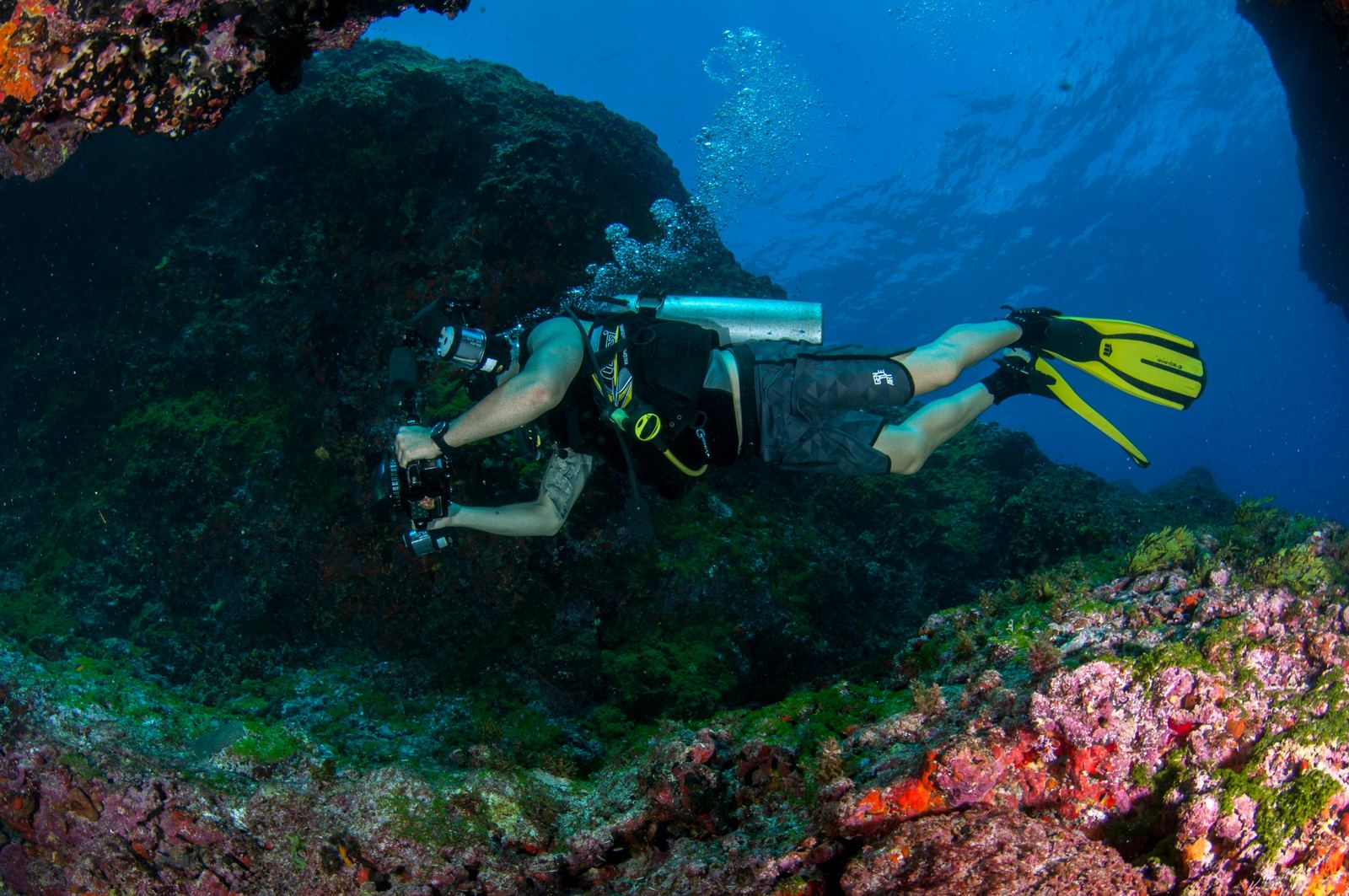
Pick an island, the month you will be there and your level of training. The finder returns the sites from our island guides that suit you, sorted so the ones that are usually diveable that month come first and the swell-dependent ones follow. Sites that usually close that month, or that need more training than you selected, are left out.
How the Finder Decides
The finder uses the same data as our island dive-site pages. Every site carries four facts that matter here:
- Island and entry. Whether you walk in from shore or need a boat.
- Training. The minimum level a shop will usually expect: snorkel, Discover Scuba with an instructor, Open Water (about 60 feet) or Advanced Open Water (about 100 feet). Choosing a level includes every site at or below it.
- Exposure. Which way the site faces and so which swell reaches it: north-facing, south-facing, west-facing, the sheltered Kona coast, the Molokini channel, or the long open-ocean crossing to Niʻihau.
- Protected status. Whether the site is inside a state Marine Life Conservation District.
Exposure is turned into a month-by-month rating using the long-term swell pattern described in University of Hawaiʻi surf climatology and reflected in National Weather Service high-surf criteria: north and northwest swell in winter, south swell in summer, and a sheltered leeward coast on Hawaiʻi Island.
What the ratings mean. "Usually diveable" means the site faces away from that season's main swell, so operators run it on most days. "Swell-dependent" means it is diveable on calm days but a swell in the forecast will close it. "Usually closed" means the site faces straight into that season's surf and should not be planned around. None of these is a forecast. Always check the NWS Honolulu surf forecast and Hawaii Beach Safety in the days before you dive, and follow your operator's call on the morning.
Using the Results Well
Treat the list as a shortlist to take to a dive shop, not a booking decision. Three habits get the most out of it:
- Look one level up and one level down. If you are a new Open Water diver, switch the training filter to "Not certified" to see the calmest, shallowest options for your first day back in the water. If you are logging your Advanced dives, switch up to see what opens.
- Check the shoulder months. April and October are transition months for north-facing sites. If your trip straddles them, check both months and plan the north-shore dives for whichever end is closer to summer.
- Keep a backup on another coast. Each island has at least one site that tends to work when the others do not: the Honolulu wrecks in winter, Mala Wharf on Maui, Koloa Landing on Kauaʻi, and the Kona coast almost any time.
Before you lock anything in, read the full briefing for each site you like, including access and parking, county ocean safety and the rules inside protected areas. If a summit drive is on your list, read the flying and altitude guide too.
Every Site in the Finder
| Site | Island | Entry | Minimum level |
|---|---|---|---|
| YO-257 & San Pedro wrecks | Oʻahu | Boat | Advanced Open Water recommended |
| Sea Tiger | Oʻahu | Boat | Advanced Open Water recommended |
| Corsair plane wreck | Oʻahu | Boat | Advanced Open Water recommended |
| Mahi shipwreck | Oʻahu | Boat | Advanced Open Water recommended |
| Electric Beach (Kahe Point) | Oʻahu | Shore | Open Water |
| Shark's Cove & Three Tables | Oʻahu | Shore | Open Water |
| Hanauma Bay Nature Preserve | Oʻahu | Shore | Snorkel / any level |
| Molokini Crater (inside) | Maui & Lānaʻi | Boat | Discover Scuba (with instructor) and up |
| Molokini Back Wall | Maui & Lānaʻi | Boat | Advanced Open Water recommended |
| Five Caves / Mākena Landing | Maui & Lānaʻi | Shore | Open Water |
| Ulua Beach | Maui & Lānaʻi | Shore | Discover Scuba (with instructor) and up |
| Mala Wharf | Maui & Lānaʻi | Shore | Open Water |
| Black Rock (Puʻu Kekaʻa) | Maui & Lānaʻi | Shore | Open Water |
| Honolua Bay | Maui & Lānaʻi | Shore | Open Water |
| First & Second Cathedral, Lānaʻi | Maui & Lānaʻi | Boat | Open Water |
| Manta Village (Keauhou) | Hawaiʻi Island (Big Island) | Boat | Open Water |
| Garden Eel Cove (Manta Heaven) | Hawaiʻi Island (Big Island) | Boat | Open Water |
| Kealakekua Bay (Kaʻawaloa Cove) | Hawaiʻi Island (Big Island) | Boat | Open Water |
| Two Step (Hōnaunau Bay) | Hawaiʻi Island (Big Island) | Shore | Open Water |
| Puakō | Hawaiʻi Island (Big Island) | Shore | Open Water |
| Old Kona Airport (Pāwai Bay area) | Hawaiʻi Island (Big Island) | Shore | Open Water |
| Blackwater / pelagic night dive | Hawaiʻi Island (Big Island) | Boat | Advanced Open Water recommended |
| Koloa Landing | Kauaʻi | Shore | Discover Scuba (with instructor) and up |
| Sheraton Caverns | Kauaʻi | Boat | Open Water |
| Brennecke's Ledge | Kauaʻi | Boat | Advanced Open Water recommended |
| Tunnels (Makua) Beach | Kauaʻi | Shore | Open Water |
| Niʻihau & Lehua | Kauaʻi | Boat | Advanced Open Water recommended |
Spotted a site that has changed, or one we should add? Tell us through the contact page; corrections are logged on our corrections page.